
Bellevue, WA · Neighborhood guide
Wilburton
Bellevue's district east of I-405 — the Botanical Garden, Wilburton Hill Park, the 1904 trestle now becoming Eastrail, and the working NE 8th commercial core.
- 2parks
- 2shops
- 1attractions
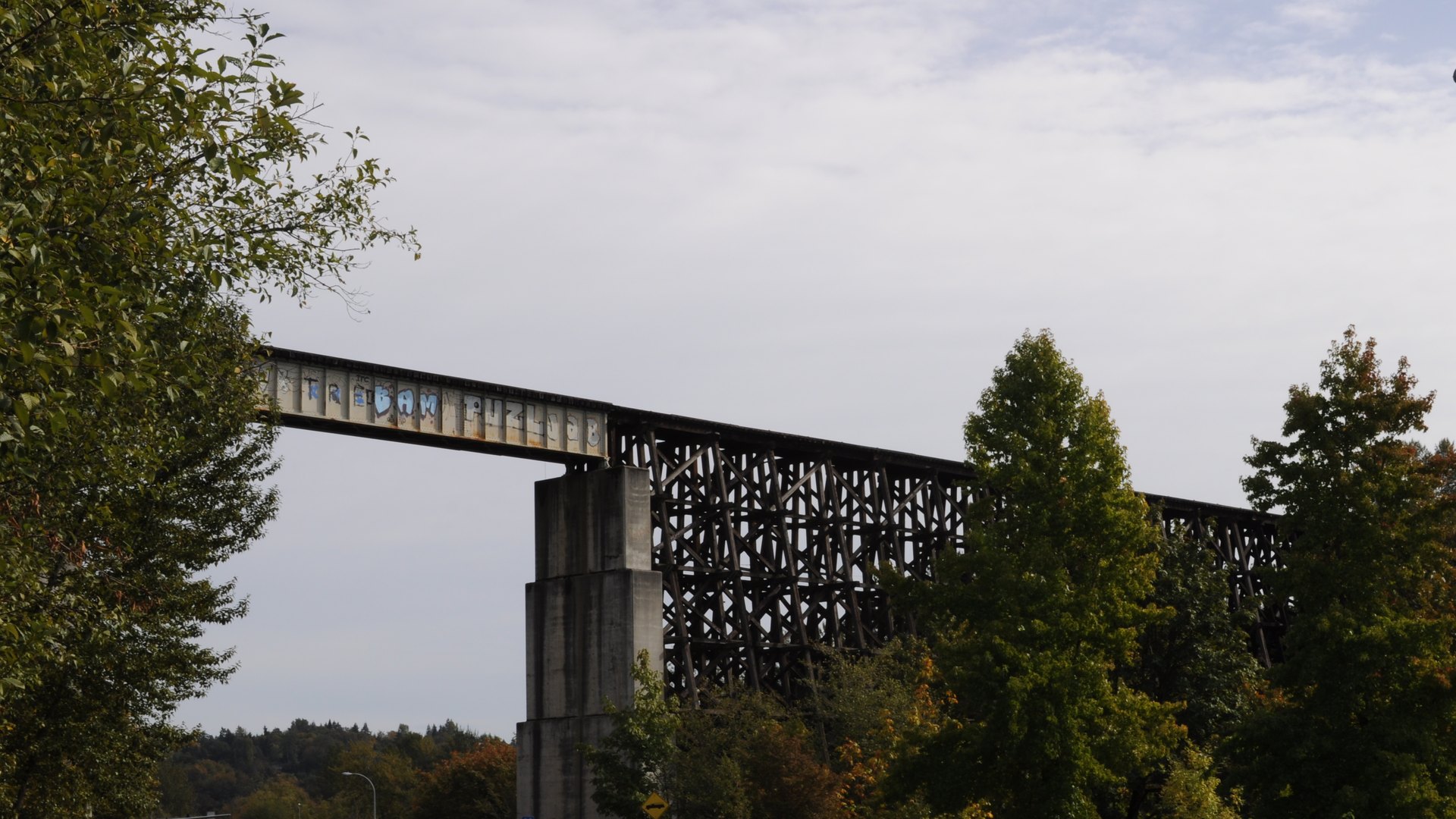
The Wilburton Trestle, built in 1904 and now being rebuilt as an elevated section of Eastrail.Photo by Joe Mabel · CC BY-SA 3.0 · License
At a glance
Is Wilburton right for your day?
- Best for
- Garden and trail walkers, families, railway and industrial-history readers, and repeat Bellevue visitors who have finished Downtown and want the city's working edge.
- Time to spend
- Half a day: the Botanical Garden and Wilburton Hill Park together, plus lunch on the NE 8th corridor.
- What makes it unique
- It is the only Bellevue neighborhood where a 53-acre botanical garden, a century-old railroad trestle and a light-rail station sit within a mile of each other.
- Nearby, often missed
- The view up at the Wilburton Trestle from the Lake Hills Connector — 102 feet of 1904 timber that most drivers pass under without looking.
- A local would send you here first
- Park at the Bellevue Botanical Garden, walk through the display gardens into Wilburton Hill Park and around the Owl Loop, then drive five minutes east to Kelsey Creek Farm Park.
Editor's note
Why Wilburton is worth your time
Wilburton is the piece of Bellevue most people drive over without naming. It begins the moment you cross I-405 east of Downtown, and it holds the Bellevue Botanical Garden, Wilburton Hill Park, the Eastrail corridor and its 1904 timber trestle, and a working commercial strip along NE 8th Street between 116th and 120th.
Its edges are unusually legible. Interstate 405 is the western wall. Bel-Red, the redeveloping industrial corridor, sits to the north. The Lake Hills Connector and Kelsey Creek mark the southeastern edge, with Lake Hills beyond. Wilburton is the hinge between all three, which is exactly why it has been so hard to define — and why the City treats the Wilburton / N.E. 8th Street area as a commercial core inside the neighborhood rather than as the whole of it.
Editor's picks
Where we'd send you first in Wilburton

Bellevue Botanical Garden
4.8A free 53-acre public botanical garden in Wilburton with the celebrated Perennial Border, Yao Japanese Garden, Ravine Experience suspension bridge, and the annual Garden d'Lights holiday show.
Wilburton

Wilburton Hill Park
4.6Hilltop park with sports fields, gardens, and city views.
Wilburton

Kelsey Creek Farm Park
Bellevue's 150-acre historic farm park — free admission, live barnyard animals daily, two 1930s-40s dairy barns, playground, and quiet wooded trails minutes from downtown.
Wilburton
Character
The feel of Wilburton
History & character
Rail and mill. Wilburton exists because of timber and the railroad. Logging began here in the 1890s, and the first sawmill was built in 1903 by George England and Manley Wilbur — the source of the name. The town of Wilburton was platted in 1904, the same year the Northern Pacific Railway completed a timber trestle across the valley as part of its Lake Washington Belt Line. From 1905 the Hewitt-Lea Lumber Company ran the logging and milling operation, with a spur that followed Kelsey Creek toward Lake Hills; the mill buildings stood near the base of the trestle, under what is now the I-405 overpass, supported by a town of more than 350 people. The mill closed in 1919 when the harvestable timber ran out, and by the end of the 1920s the mill and its structures were gone. Wilburton was annexed by Bellevue in 1967.
Farming, and what happened in 1942. After the clearing came farms. Japanese immigrants had been arriving in Bellevue since 1898, and by the 1920s Japanese American families were the backbone of the local agricultural economy — strawberries above all, grown on roughly 472 acres, alongside lettuce and other produce sold largely through Seattle's Pike Place Market. That crop is the reason the first Bellevue Strawberry Festival was held in 1925.
In the spring of 1942, under Executive Order 9066, about 60 Bellevue Japanese American families were forcibly removed from their homes and farms. Most were held first at the Pinedale Assembly Center north of Fresno, California — the temporary detention facility that took nearly all Japanese Americans removed from western Washington outside Seattle — and then incarcerated at the Tule Lake concentration camp. Anti-Japanese agitation in Bellevue predated the war, and local white leaders lobbied for removal. Some families returned afterwards and many did not; those who came back found burned buildings, fallow fields and signs telling them to leave. The suburb built here afterwards stands on that dispossession, and any honest account of Wilburton's farm history has to say so. The Eastside Heritage Center and Densho hold the primary records; we point to them rather than paraphrase the families' own accounts.
Auto Row. Post-war, the 116th Avenue NE frontage became Bellevue's auto strip — dealerships, body shops, parts counters and the service trades around them. Much has been redeveloped, but the pattern is still readable in the deep lots, wide curb cuts and surviving independent garages along 116th. It is why Wilburton reads as workaday next to Downtown's towers, and part of why the City's redevelopment plans for the area are as contested as they are.
Local personality
Wilburton is not a destination strip and does not pretend to be. It is a neighborhood of parks on a hill, a freeway edge, a rail corridor becoming a trail, and a grocery-anchored commercial spine that serves the blocks around it. Visitors come for the Botanical Garden and, in December, for Garden d'Lights; the rest of the time the loudest thing here is traffic on NE 8th.
That is also the appeal. On the Wilburton Hill side you can walk from a formal display garden into 105 acres of sports fields and second-growth forest without crossing a road. A mile north, cranes are rebuilding the same neighborhood around a light-rail station. Few places in Bellevue let you see the old city and the next one in a single afternoon.
Off the guidebook
Hidden gems in Wilburton
The Owl Loop. A 0.6-mile wooded circuit in Wilburton Hill Park that most Botanical Garden visitors never notice, reached from the park's upper lot.
The trestle from below. The Lake Hills Connector was cut through the trestle in 1973, so you can drive or walk beneath it and see the scale of the timber lattice up close — the deck itself is a construction site until the Eastrail rehabilitation finishes.
Kelsey Creek Farm Park. At the neighborhood's eastern edge, a working farm landscape with barns and livestock — the surviving trace of the valley's agricultural period, and free to walk.
Outdoors
Parks & trails in Wilburton
Bellevue Botanical Garden
4.8A free 53-acre public botanical garden in Wilburton with the celebrated Perennial Border, Yao Japanese Garden, Ravine Experience suspension bridge, and the annual Garden d'Lights holiday show.
Wilburton
Wilburton Hill Park
4.6Hilltop park with sports fields, gardens, and city views.
Wilburton
Shopping
Where to shop in Wilburton


Things to do
Attractions in Wilburton
Timing & framing
When and how to see Wilburton
Photography spots
Under the Wilburton Trestle, from the Lake Hills Connector, where the 1904 timber lattice reads against the sky.
The Yao Garden bridge at the Bellevue Botanical Garden, best in the last hour of light.
The Wilburton Hill summit picnic shelter, looking west toward Downtown over the tree line.
Garden d'Lights in December, at the Botanical Garden — a tripod and a weeknight beat a weekend crowd.
Seasonal highlights
Late April to mid-June is peak bloom at the Botanical Garden, and the best walking weather on Wilburton Hill.
Summer brings the sports fields and playground at Wilburton Hill Park into constant use; go early for parking.
October is the quietest and most photogenic month on the hill.
Late November to early January is Garden d'Lights at the Botanical Garden — timed entry, and far calmer on a weeknight before 8pm.
With kids
Family highlights in Wilburton
Wilburton Hill Park has one of the better playgrounds on this side of the freeway, plus ball fields and a large picnic shelter. Kelsey Creek Farm Park, at the eastern edge, is a free working farm with barns and animals and is the neighborhood's default rainy-Saturday outing. The Botanical Garden is stroller-friendly through its main loop and free year-round, and Garden d'Lights in December is built for children.
Practical
Getting here & getting around
Parking & transit
Wilburton Station on the 2 Line serves the neighborhood at 800 118th Ave NE, a short walk from the NE 8th commercial core. The station has no commuter parking, and it is not the same place as the Wilburton Park & Ride at 720 114th Ave SE. Full parking, access and connection detail — including which lots actually work for a 2 Line trip — is in our Wilburton Station guide; this page does not repeat it.
For the parks, drive or take a bus: the Bellevue Botanical Garden and Wilburton Hill Park share free lots off Main Street at 12001 and 12400 Main St, which fill on summer weekends and during Garden d'Lights.
Accessibility
The Bellevue Botanical Garden has paved and hard-surface paths through the core display gardens and accessible parking at the Aaron Education Center; the Ravine Experience suspension bridge and some woodland loops are not step-free. Wilburton Hill Park's upper areas and picnic shelters are reachable by paved path, while the Owl Loop is soft-surface forest trail with roots and grade. The NE 8th corridor has sidewalks throughout but long signalised crossings and heavy turning traffic. The Eastrail trestle deck is closed during rehabilitation.
On the map
Where Wilburton is
FAQ
Frequently asked about Wilburton
- Where is Wilburton in Bellevue?
- Wilburton is the City-documented neighborhood area immediately east of Interstate 405 from Downtown Bellevue, running north toward the Bel-Red corridor and southeast to the Lake Hills Connector and Kelsey Creek. The Wilburton / N.E. 8th Street area is its commercial core, not the whole neighborhood.
- What is Wilburton known for?
- The Bellevue Botanical Garden and Wilburton Hill Park on its southern hill, the 1904 Wilburton Trestle on the Eastrail corridor, Kelsey Creek Farm Park at its eastern edge, and the NE 8th Street commercial strip between 116th and 120th Avenue NE.
- Can you walk across the Wilburton Trestle?
- Not yet. King County began rehabilitating the trestle in May 2024 to carry an 18-foot-wide elevated section of Eastrail, with opening anticipated in mid-2027. Until then you can see it from below along the Lake Hills Connector.
- Is there parking at Wilburton Station?
- No. Wilburton Station at 800 118th Ave NE has no commuter parking. The separate Wilburton Park & Ride at 720 114th Ave SE is a King County Metro lot, not a station garage. See our Wilburton Station guide for the full parking and access picture.
- How did Wilburton get its name?
- From the sawmill built on the site in 1903 by George England and Manley Wilbur. The town of Wilburton was platted in 1904, the Hewitt-Lea Lumber Company took over milling in 1905, and Bellevue annexed the area in 1967.
- What happened to Wilburton's Japanese American farms?
- Japanese American families farmed strawberries and produce across Bellevue from the early 1900s and grew the crop behind the first Strawberry Festival in 1925. In 1942, under Executive Order 9066, roughly 60 Bellevue families were forcibly removed, held at the Pinedale Assembly Center near Fresno and then incarcerated at Tule Lake. Many never returned. The Eastside Heritage Center and Densho hold the primary records.
Keep exploring
Related guides
Nearby neighborhoods
Keep wandering