

Bellevue, WA · Neighborhood guide
Lake Hills
Bellevue's 1950s garden suburb — a wetland greenbelt strung between Larsen and Phantom lakes, city-run blueberry fields, and a rebuilt village center.
- 1parks
- 1shops
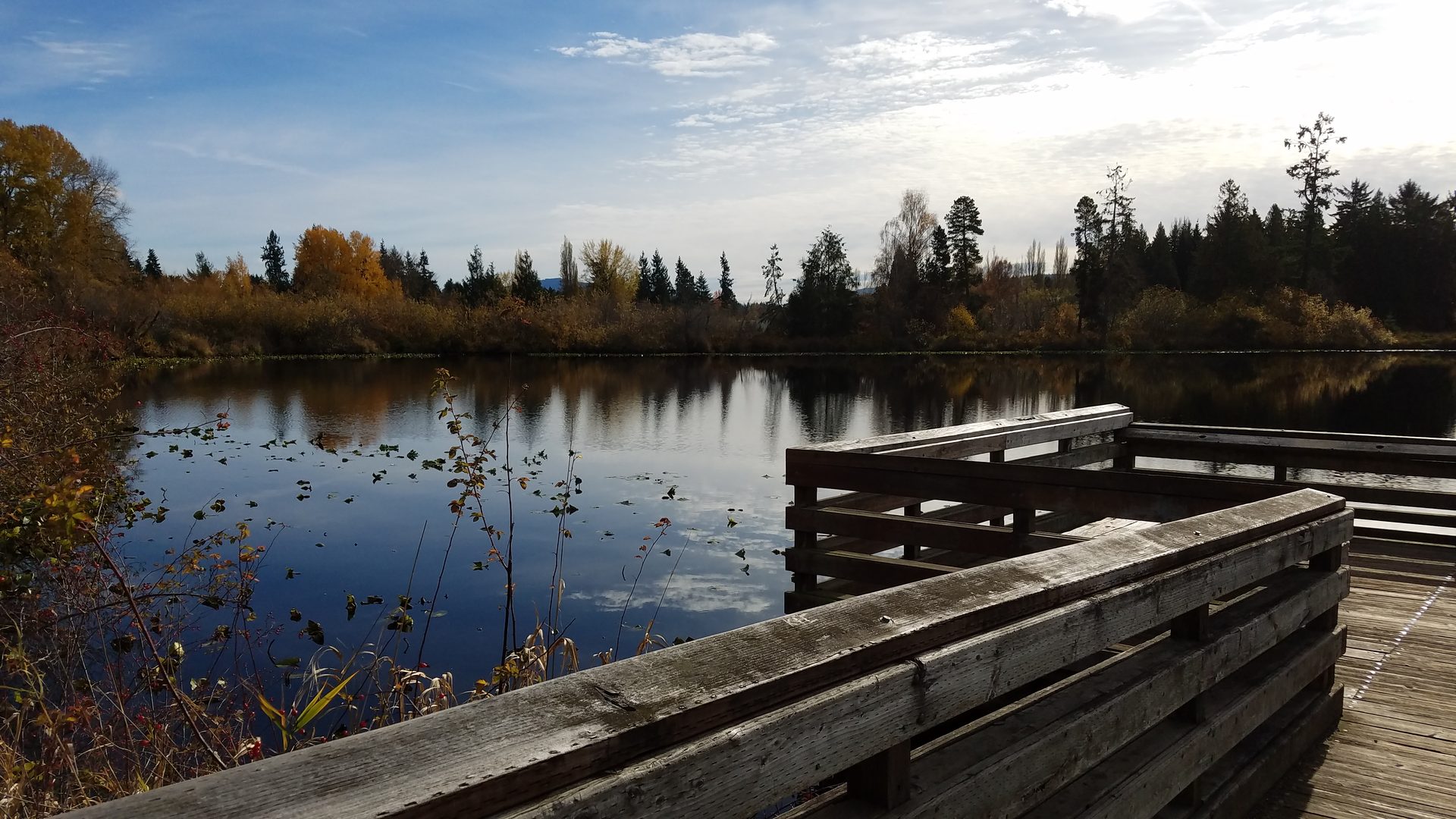
Larsen Lake, the wetland heart of the Lake Hills Greenbelt.Photo by Mark Yasuda · CC BY-SA 4.0 · License
At a glance
Is Lake Hills right for your day?
- Best for
- Walkers, families with young children, dog owners, gardeners, and second-time Bellevue visitors who have already done Downtown and want to see how the city's postwar suburbs actually live.
- Time to spend
- Two hours for a greenbelt walk and lunch at the village. Half a day in blueberry season if you pick.
- What makes it unique
- It is the only Bellevue neighborhood where a city-run working blueberry farm, a wetland greenbelt and a 1950s subdivision occupy the same half mile.
- Nearby, often missed
- The Phantom Lake Loop — a 2.4-mile paved circuit around the lake with a small dock — is signposted from 156th Avenue SE and gets a fraction of the traffic the greenbelt does.
- A local would send you here first
- Park at the Ranger Station on SE 16th Street, walk the greenbelt out toward Larsen Lake past the pea patches and the demonstration garden, then eat at Lake Hills Village and give the library ten minutes.
Editor's note
Why Lake Hills is worth your time
Lake Hills is the part of Bellevue that most visitors drive past without ever registering. It is a postwar subdivision — roughly 4,000 ranch and split-level houses laid across about 1,200 acres, begun in 1954 and opened in 1955 — that has quietly aged into one of the greenest walkable pockets on the Eastside. The reason to come is not the housing stock. It is the corridor of wetland, farm and trail that runs through the middle of it.
The Lake Hills Greenbelt links Larsen Lake and Phantom Lake through a wetland the city describes variously as more than 150 acres and about 172 acres, with two to three miles of flat trail depending on which city publication you read. Along it sit working blueberry fields the city has farmed since the 1940s, a ranger station on SE 16th Street, community pea-patch plots and a Master Gardener demonstration garden. At the north end, Lake Hills Village is the 2000s rebuild of the 1958 Lake Hills Shopping Center, now anchored by a King County Library System branch and an Overlake primary-care clinic rather than the QFC that left in 2001.
We would not send a first-time Bellevue visitor here ahead of Downtown. We would send a second-time visitor, or anyone travelling with children, a camera or a dog. Lake Hills rewards a slow two hours on foot far more than it rewards a drive-through.
Editor's picks
Where we'd send you first in Lake Hills

Lake Hills Greenbelt
4.6Wetland greenway with a working farm and trails.
Lake Hills

Lake Hills Village
Mixed-use neighborhood center with the Lake Hills library, a primary-care clinic, and independent restaurants.
Lake Hills
Robinswood Community Park
Community park with tennis, fields, and Robinswood House.
Lake Hills
Character
The feel of Lake Hills
History & character
The land now called Lake Hills was farmed before it was subdivided. Japanese American families were among the first to clear the forested hills west of Lake Sammamish and plant them in berries; the 1942 wartime incarceration ended most of that farming, and only a fraction of Bellevue's Japanese American farming families returned. The city's blueberry fields at Larsen Lake, established in the 1940s and still worked by Bellevue Parks, are the visible remainder of that agricultural period.
The suburb itself was assembled by developer R. H. "Dick" Connor, who acquired roughly 1,200 acres in 1954. Houses opened for sale in 1955 and construction continued through the late 1950s; by 1963 about 4,000 homes stood on the site. Lake Hills Shopping Center — 6.7 acres, and home to the very first QFC — opened in 1958. The neighborhood was not annexed by Bellevue until 1969, more than a decade after it was built, and a year after its first standalone library building opened in 1968.
That sequence explains the character: Lake Hills was a self-contained town before it was part of a city, and it still behaves like one.
Local personality
Weekday mid-morning is the honest version of Lake Hills: dog walkers on the greenbelt gravel, retirees at the pea patches, a stroller convoy heading for the library, and the produce stand near SE 16th Street doing quiet business. There is no scene here and no attempt at one. The neighborhood's social center is a library branch and a supermarket-scale parking lot, and residents seem entirely satisfied with that arrangement.
Off the guidebook
Hidden gems in Lake Hills
The Urban Demonstration Garden beside the greenbelt is run with WSU Extension Master Gardeners and hosts workshops through the growing season — a genuinely instructive stop if you garden at all, and almost never visited by anyone from outside the neighborhood.
The community garden and pea-patch plots are leased through the Lake Hills Ranger Station on SE 16th Street. Walking the rows is free and shows you what actually grows in this climate.
"Encyclopedia of Ramps", the Lead Pencil Studio artwork commissioned for the Lake Hills Library when the current building opened in September 2010, is the only piece of serious contemporary art in the neighborhood and sits in a branch library most visitors never enter.
Robinswood Park's ten wooded acres are separate from its ballfields — a small trail network and pond behind the sports complex, with two fenced off-leash corrals that regular dog owners treat as the neighborhood's living room.
Outdoors
Parks & trails in Lake Hills
Shopping
Where to shop in Lake Hills
Timing & framing
When and how to see Lake Hills
Photography spots
The Larsen Lake blueberry rows in late summer, shot low and along the row line, are the neighborhood's one distinctive frame. Early morning fog over the greenbelt wetland between Larsen and Phantom lakes is the other. The small dock on the Phantom Lake Loop gives a clean water-level view east. Robinswood's pond photographs best in the hour before sunset. All of these are public land; the blueberry fields are a working farm, so stay on the marked rows.
Seasonal highlights
Summer is the reason to plan a visit. The city opens U-pick at its Larsen Lake and Mercer Slough blueberry farms on dates it sets and announces each year — there is no fixed calendar, and the season is closed once the city says it is closed, so check the Bellevue Parks blueberry page before you drive out.
Spring and early autumn are the better trail months: the greenbelt is flat, largely open to the sky, and the wetland is at its most legible when the vegetation is low. Winter is unspectacular but perfectly walkable; expect standing water on the unpaved sections after sustained rain. We are not aware of a recurring festival or annual event held specifically in Lake Hills.
With kids
Family highlights in Lake Hills
Robinswood Community Park is the anchor for families: a children's play area, lighted softball and soccer or lacrosse fields, open lawn, a pond, picnic areas and two off-leash dog corrals. It is the easiest place in the neighborhood to spend an unstructured afternoon.
The Lake Hills branch library at 15590 Lake Hills Boulevard sits inside Lake Hills Village, which means a children's library, lunch and parking are all in one stop. The greenbelt's working blueberry fields and produce stand give younger children a farm experience without a drive out of the city, and the trail between the two lakes is flat enough for short legs.
Practical
Getting here & getting around
Parking & transit
This is a driving neighborhood, and we will not pretend otherwise. There is no light rail station in Lake Hills; the nearest 2 Line stations are in Wilburton and Downtown Bellevue, several miles west and not a walkable connection.
King County Metro route 223 runs through the core, with stops at 156th Avenue SE and Lake Hills Boulevard, linking Eastgate Park-and-Ride with Downtown Redmond. Service is useful for a one-way visit rather than for hopping between trailheads.
Parking is free and informal: surface stalls plus an underground garage at Lake Hills Village, and small lots at the greenbelt entry points — the community gardens and produce stand at 15500 SE 16th Street, the Ranger Station at 15416 SE 16th Street, Larsen Lake Blueberry Farm at 14812 SE 8th Street, and Phantom Lake Park at 2034 156th Avenue SE. The greenbelt lots are small and fill on warm summer weekends.
Accessibility
The city publishes no formal accessibility rating for the Lake Hills Greenbelt trails. The terrain is flat, with a mix of paved sections, boardwalk and compacted surface; conditions on the unpaved stretches vary with the weather. Treat it as easy walking rather than as a certified accessible route.
The Phantom Lake Loop is the more predictable option: the city describes it as a paved pathway ten to twelve feet wide running about 2.4 miles around the lake, connecting west to the greenbelt, east to Weowna Park and northwest toward Robinswood. It begins at 156th Avenue SE and SE 16th Street.
Robinswood Community Park has restrooms and paved circulation around the sports fields; the ten-acre wooded trail section is unpaved. Boating on Phantom Lake is limited by the city on a first-come basis, so arrival time matters more than paperwork.
On the map
Where Lake Hills is
FAQ
Frequently asked about Lake Hills
- What is Lake Hills known for?
- The Lake Hills Greenbelt — a wetland corridor of roughly 150 to 172 acres linking Larsen Lake and Phantom Lake, with city-run blueberry fields, community gardens and two to three miles of flat trail — plus one of the earliest large postwar subdivisions on the Eastside.
- Can you pick blueberries in Lake Hills?
- Yes. Bellevue Parks runs U-pick at the Larsen Lake blueberry farm, which has been in production since the 1940s. The city sets and announces the season dates each year, so check the Bellevue Parks blueberry farms page before visiting.
- Is Robinswood Park in Lake Hills or Eastgate?
- Lake Hills. The City of Bellevue's own Eastgate planning documents state that Robinswood Park lies north of the Eastgate neighborhood area, within Lake Hills, and that Eastgate's northern edge is SE 28th Street.
- How do you get to Lake Hills without a car?
- King County Metro route 223 serves 156th Avenue SE and Lake Hills Boulevard between Eastgate Park-and-Ride and Downtown Redmond. There is no light rail station in the neighborhood; the nearest 2 Line stops are in Wilburton and Downtown Bellevue, several miles west.
- When was Lake Hills built?
- Developer R. H. Connor assembled about 1,200 acres in 1954 and the first homes opened in 1955; roughly 4,000 houses stood by 1963. The neighborhood was annexed by the City of Bellevue in 1969.
Keep exploring
Related guides
Nearby neighborhoods
Keep wandering

